
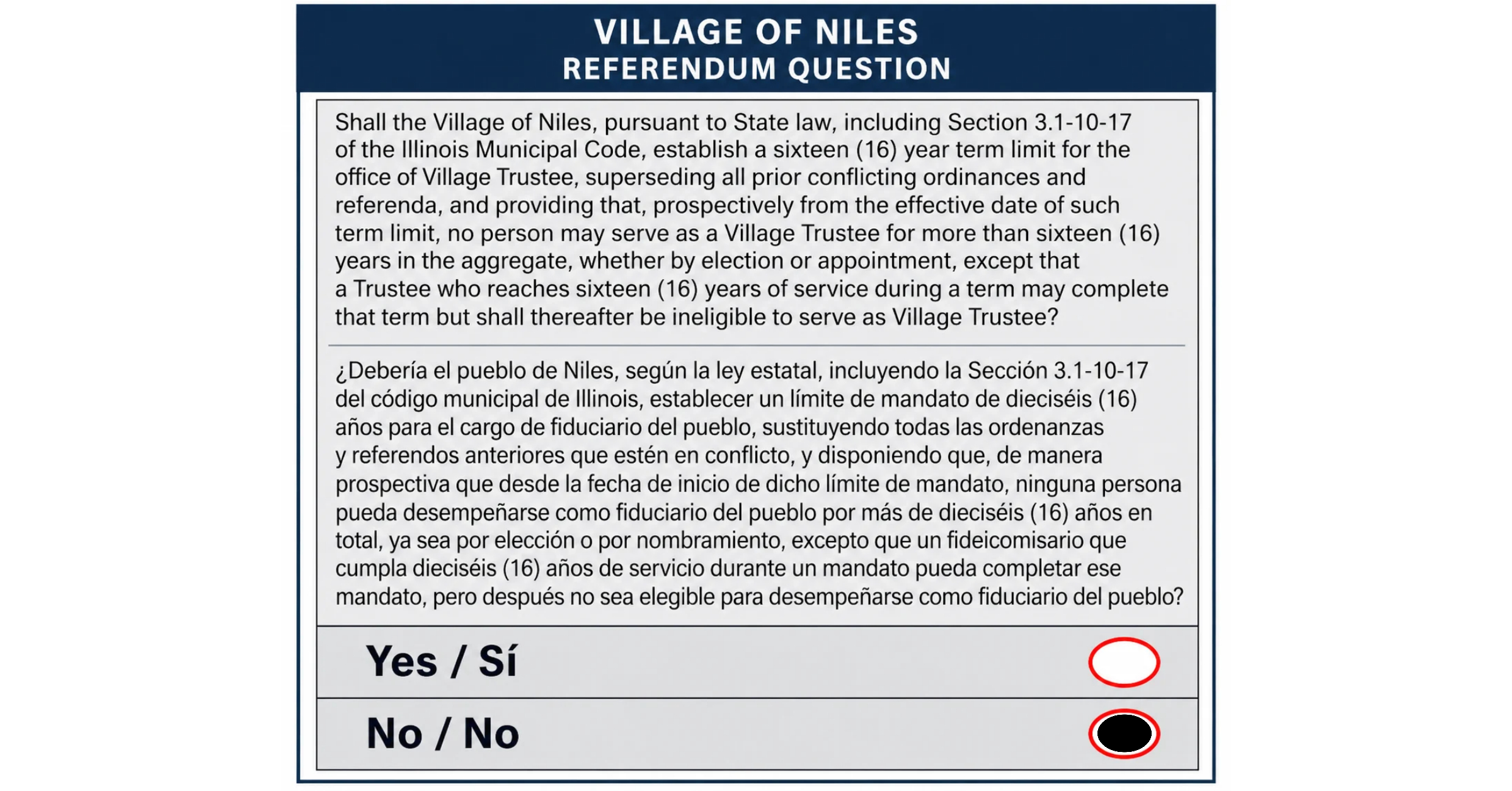
Niles voters rejected a 20-year term-limit proposal in March. This November, they are being asked to consider a different proposal establishing a prospective 16-year limit for Village Trustees.
Ballot questions are not always easy to understand. Sometimes a few words can make a big difference in what voters are actually being asked to approve.
That is why Referendum #3 on the November 3 ballot deserves a careful read.
At its heart, the question is about term limits for Niles Village Trustees.
The referendum asks whether Niles should establish a new limit of 16 years of service as a Village Trustee.
But there is more to this question than the number 16.
To understand what voters are being asked to decide, it helps to look at how we got here.
Niles Voters Approved Term Limits in 2013
Niles voters have a history with this issue.
In 2013, two different term-limit questions appeared on the ballot, and voters approved both by large margins.
According to official election results, one received:
3,122 YES votes and 623 NO votes, or 83.36% YES.
The other received:
3,195 YES votes and 659 NO votes, or 82.90% YES.
The two questions were not identical.
Village records later described the term-limit rules as generally limiting a person to three full terms as Village Trustee and two full terms as Village President, with additional provisions addressing partial terms and officials who were already serving when voters approved the measures in 2013.
Each full term is four years.
That history matters because Niles voters have already made decisions about how long elected officials should be permitted to remain in office.
Voters Were Asked Again in March 2026
Term limits returned to the ballot earlier this year.
On March 17, Niles voters were asked whether current and future elected officers should prospectively be permitted to serve up to five full four-year terms, or 20 years, in the same elected office.
According to Village records, 53.67% voted NO.
The proposal did not receive majority support.
Now, less than eight months later, voters are being presented with another term-limit question.
But it is important to understand that the November question is not the same question that appeared in March.
What Is Being Proposed in November?
Referendum #3 specifically concerns the office of Village Trustee.
The actual ballot question proposes a limit of 16 years of service in the aggregate, whether someone serves as Trustee through election or appointment.
The Village describes the proposal more simply as allowing trustees to hold office for up to four four-year terms, or 16 years.
The ballot question also says that if a Trustee reaches 16 years of service during a term, that Trustee may finish the term but would thereafter be ineligible to serve as Village Trustee.
There are also two phrases in the question that deserve particular attention:
“prospectively from the effective date”
and
“superseding all prior conflicting ordinances and referenda.”
Those words are important to understanding what voters are being asked to approve.
What Does “Prospectively” Mean?
“Prospectively” means the proposed new term limit would operate going forward from its effective date.
Illinois law requires municipal term limits covered by Section 3.1-10-17, including a new term limit adopted in 2026, to operate prospectively.
Under that law, elective office held before the effective date of a newly imposed term limit cannot be used to prevent an otherwise eligible person from running for or holding office under that new limit.
That makes the November proposal more complicated than simply comparing one number with another.
It is not just a question of 12 years versus 16 years.
The existing and proposed systems are structured differently.
What Does “Superseding” Mean?
The referendum also expressly says that the new 16-year limit would be:
“superseding all prior conflicting ordinances and referenda.”
In plain language, that means the new rule is intended to take the place of earlier Village ordinances and referendum provisions to the extent they conflict with the new rule.
That is why voters should not read Referendum #3 as simply asking:
Should Niles have term limits?
Niles voters have already approved term-limit measures.
The November question asks whether voters want to establish the new prospective 16-year trustee term-limit system described in Referendum #3.
Why Term Limits Matter
Term limits are bigger than any one mayor, trustee or election.
They are about what kind of system residents want for their local government.
Supporters of term limits argue that they provide regular opportunities for new people to step forward, serve their community and bring new ideas into local government. They also see term limits as a way of preventing one person from remaining in the same elected office indefinitely.
Others argue that allowing longer service can provide experience, institutional knowledge and continuity in government.
Those are considerations voters must weigh for themselves.
But whatever your position on term limits, understanding the history matters.
Niles voters approved term-limit measures in 2013.
Voters were presented with another term-limit proposal in March 2026, which would have allowed up to 20 years in the same elected office. A majority voted NO.
Now voters are being presented with a different proposal in November 2026, specifically addressing Village Trustees and establishing a prospective 16-year aggregate limit.
What Does YES or NO Mean?
The Village of Niles explains the November choices directly.
A YES vote means you support trustees holding office for up to four four-year terms, or 16 years.
A NO vote means you do not support trustees holding office for up to four four-year terms, or 16 years.
The November referendum therefore deserves more than a quick glance.
Read the Entire Question Before You Vote
Read Referendum #3 carefully.
Pay particular attention to these words:
“16 years in the aggregate”
“whether by election or appointment”
“prospectively from the effective date”
and
“superseding all prior conflicting ordinances and referenda.”
Each phrase tells voters something important about the proposed system.
Look at what Niles voters approved in 2013.
Look at what voters were asked in March 2026.
Then look closely at what is being proposed in November.
The November question is different from the March question, but both concern how term limits should operate in Niles.
Consider the differences between the existing rules and the proposed new system. Consider how long you believe someone should be permitted to serve as a Village Trustee.
Then make your own decision.
Niles voters will decide whether this proposed term-limit system is adopted.
Sources
Village of Niles, Illinois
-
“Referenda,” 2026 election information, including the official language and Village explanation of Referendum #3.
-
Village Board of Trustees meeting records, including April 28, 2026 public-question results from the March 17, 2026 election.
-
Village Board records concerning the 2013 term-limit referenda and subsequent term-limit provisions.
-
Village Focus, Spring 2019, explanation of Village term-limit provisions.
Cook County Clerk
-
Official April 9, 2013 Consolidated Election results for the Village of Niles term-limit questions.
Illinois General Assembly
-
Illinois Municipal Code, 65 ILCS 5/3.1-10-17, “Term limits.”
-
Public Act 101-0114, establishing Section 3.1-10-17 of the Illinois Municipal Code.
Illinois Courts
-
Illinois appellate court records addressing the Niles term-limit referendum history and the language of the 2013 citizen-initiated term-limit question.