
After Case # fields were blank in 93.4% of June records and 88.4% of July records, the blank rate fell to 8.2% in August. Hundreds of later records contained entries such as “NA,” “1,” “PCS” and “zz,” whose meanings are not established by the records produced by Niles.
A deeper Niles Connect review of 5,719 Niles Police Department Flock audit records found that the department’s use of Flock’s Case # field changed dramatically during the summer of 2025.
The records cover June 1, 2025 through February 6, 2026. The earlier Niles Connect analysis found that 1,781 records, or 31.1%, had a blank Case # field. That calculation remains correct, but a row-by-row review shows the underlying documentation practices were more complicated.
Some officers appear to have placed a case number in the separate Reason field while leaving Case # blank. Later, after the Case # field suddenly became populated in nearly every record, officers used a wide range of entries that did not always resemble conventional police case numbers.
The Key Finding
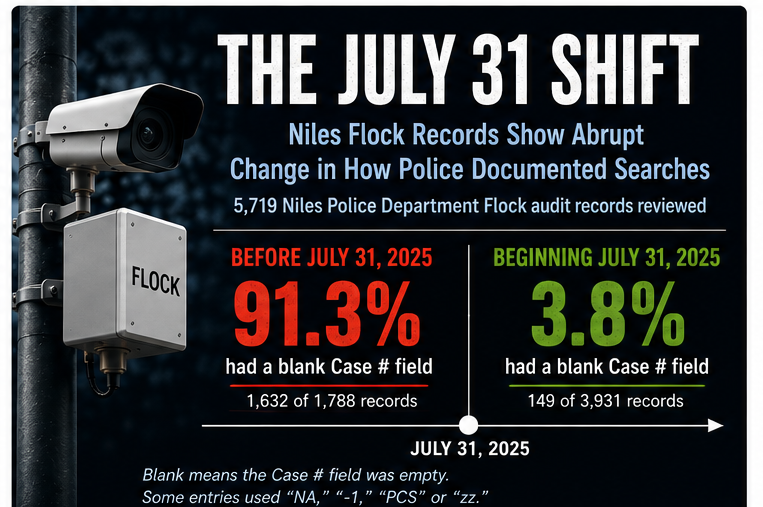
Before July 31, 2025, 1,632 of 1,788 Flock audit records had a blank Case # field, a rate of 91.3%. Beginning July 31, only 149 of 3,931 records had a blank Case # field, a rate of 3.8%.
An Almost Overnight Change
The shift was not gradual. On July 29, 2025, 45 of 49 audit records had a blank Case # field. On July 30, 80 of 131 were blank. On July 31, only 1 of 18 was blank.
On August 1, none of the 13 audit records reviewed had a blank Case # field.
| Period | Total Records | Blank Case # | Blank Rate |
|---|---|---|---|
| Before July 31, 2025 | 1,788 | 1,632 | 91.3% |
| July 31, 2025-Feb. 6, 2026 | 3,931 | 149 | 3.8% |
The records establish that the documentation pattern changed. They do not, by themselves, establish why it changed or whether Niles changed a Flock system setting on July 31.
The Monthly Pattern
| Month | Audit Records | Blank Case # | Blank Rate |
|---|---|---|---|
| June 2025 | 732 | 684 | 93.4% |
| July 2025 | 1,074 | 949 | 88.4% |
| August 2025 | 777 | 64 | 8.2% |
| September 2025 | 509 | 11 | 2.2% |
| October 2025 | 831 | 4 | 0.5% |
| November 2025 | 872 | 63 | 7.2% |
| December 2025 | 258 | 1 | 0.4% |
| January 2026 | 586 | 5 | 0.9% |
| Feb. 1-6, 2026 | 80 | 0 | 0.0% |
Some Case Numbers Were Entered in the Reason Field
The deeper review also found that a blank Case # field did not always mean the audit record lacked case-identifying information elsewhere.
More than 400 of the 1,781 records with a blank Case # field contained a case-number-like entry in the separate Reason field. Examples included entries formatted like 2025-20382, 25-19415, and descriptive entries such as Theft 2025-15932.
That finding means the earlier 31.1% statistic should be understood precisely: 1,781 records had a blank Case # field. It should not be interpreted to mean that all 1,781 records lacked a case number or case information anywhere in the audit record.
A Populated Field Did Not Always Look Like a Case Number
The reverse was also true. A nonblank Case # field did not necessarily contain what appears to be a conventional incident or case number.
Among the 3,938 records with a nonblank Case # field, several recurring entries were abbreviations, short text entries or broad numeric values.
| Entry in Case # field | Records |
|---|---|
NA variants |
530 |
PCS variants |
123 |
25 |
78 |
1 |
59 |
2025 |
54 |
zz |
46 |
2026 |
32 |
None |
8 |
Those eight groups account for 930 audit records. Niles Connect is not characterizing all of those entries as invalid. Flock has described its system as supporting case numbers or case codes, and some agencies may use internally defined codes. The records produced by Niles, however, do not explain what each of these entries means or whether they were department-approved codes.
Different Users Documented Searches Differently
The data also show that the apparent documentation practices were not uniform among Niles users.
For some users, most blank Case # records contained an apparent case number in the Reason field. For others, that pattern was largely absent.
For example, Kevin Regal had 207 records with a blank Case # field. In 205 of those records, the Reason field contained an apparent case-number pattern. Robert Vehlow had 108 blank Case # records, with 100 containing an apparent case number in Reason. Michael Oracion had 34 blank Case # records, and all 34 contained an apparent case number in Reason.
By contrast, the blank Case # records associated with Andrew Mendez, Joshua Guerrero and John Norwood did not show the same recognizable case-number pattern in the Reason field during this review.
Those differences do not establish misconduct by any individual user. They do show that officers were not necessarily documenting searches in the same way.
What Happened After the July Shift?
The records raise a second question: once the Case # field became almost universally populated, what did Niles expect officers to enter there?
Some users frequently entered values that do not resemble conventional Niles incident numbers. For example, Mendez records included hundreds of NA variants. Norwood records frequently used PCS. Guerrero records included repeated entries of 1, 2025 and 2026.
Those entries could have meanings known within the department. The production reviewed by Niles Connect does not establish those meanings, and the values should not be assumed to represent either valid case codes or improper documentation without further records from the Village.
Why July 2025 Matters
Flock Safety now says it introduced an optional case-code requirement for law-enforcement searches in July 2025. In August 2026, the company announced that it will require case codes for all law-enforcement searches by the end of 2026, with emergency searches permitted to bypass the requirement but flagged for administrator review.
In a June 19, 2025 statement, Flock described the case-number field as a free-text field and said agencies should prescribe in their LPR policies how users populate it.
The timing is notable because the Niles audit data change sharply at the end of that same month. The records do not establish that Niles enabled Flock’s case-code requirement on July 31, 2025. Niles Connect is seeking records that could answer that question.
Niles’ Own Audit Shows Why Case Documentation Matters
A separate Niles Police memorandum dated April 29, 2026 documents a departmental review of three Flock searches conducted between January and March 2026. The auditor checked the searches against underlying police CAD or case information and concluded the sampled searches complied with department policy.
That audit provides an example of how Flock activity can be evaluated: connecting a database search to an underlying law-enforcement record and reviewing its stated purpose.
When a Case # field was blank or contained entries such as “NA,” “1,” “PCS” or “zz,” what procedure did Niles supervisors use to identify the underlying investigation during an audit?
What the Records Do and Don’t Establish
The audit records do not establish that searches with blank, unusual or nonstandard Case # entries were unauthorized, improper or illegal.
They also do not establish that a record containing a nonblank Case # entry was necessarily tied to a unique police investigation. Multiple Flock searches can relate to the same incident, and the audit dataset records search activity rather than a count of separate criminal cases.
What the records establish is a documentation pattern:
Niles Flock audit records shifted from a 91.3% blank Case # rate before July 31, 2025 to a 3.8% blank rate beginning July 31. At the same time, the populated field contained a wide variety of entries, including conventional-looking case numbers, abbreviations and short numeric or text values.
Records Niles Connect Is Seeking Next
Niles Connect is seeking additional public records to determine whether the abrupt July 2025 change resulted from a Flock configuration change, a department directive, training, or another cause.
- Records showing whether and when Niles enabled a required case-number or case-code setting in Flock.
- Configuration histories, screenshots or administrator records for that setting.
- Communications with Flock or internal communications concerning the case-number feature.
- Training, directives or instructions telling officers what to enter in the Case # field.
- Records defining entries such as
PCSor other department-approved case codes. - Policies or procedures in effect before and after July 31, 2025 concerning Flock search reasons and case documentation.
- Audit procedures used when a Case # field was blank or did not identify an obvious incident number.
By the Numbers
Audit period: June 1, 2025-February 6, 2026
Total Niles PD Flock audit records reviewed: 5,719
Blank Case # fields: 1,781
Nonblank Case # fields: 3,938
Blank rate before July 31, 2025: 91.3%
Blank rate beginning July 31, 2025: 3.8%
Blank Case # records with an apparent case number in Reason: more than 400
Selected recurring nonblank Case # entries: 530 NA variants; 123 PCS variants; 78 “25”; 59 “1”; 54 “2025”; 46 “zz”; 32 “2026”; 8 “None”
The Question Now
The deeper review shifts the focus away from a single percentage and toward the department’s documentation controls.
What changed at the end of July 2025, what did Niles require officers to enter after that change, and how did supervisors verify searches when the information entered did not clearly identify an underlying case?
Niles Connect will update this reporting when additional records or an explanation from the Village are received.